Trading-record practice packet: comparison and return chains
A complete authored packet with four record labels, three sequential segments, controlled variants and portable downloads.
Added 15 October 2026
Invented records, complete populations
This packet contains four fictional comparison records and three fictional sequential segments. All names, account labels and units are invented. XCU and YCU are teaching currencies, not exchange rates or actual instruments. The JSON contains every base input and all ten controlled cases. The CSV files repeat the fictional classification inside each row. They are reference populations, not import-ready wrappers: the tools consume the complete typed JSON inputs included in the packet. There is no actual trader, authenticated source, external audit or strategy-validation sample in this exercise.
Compare the four declared records
A and B have the same issuer, event, division, dates, currency, basis and status, with twenty and fifteen percent returns. B therefore has a negative-five-percentage-point difference from A under the tool's label rule. C differs in currency; D has unknown basis. Both receive null differences, with explicit field findings. The baseline is included with a zero difference when its fields are complete. Changing the issuer, period or status in a controlled case demonstrates a separate mismatch. These labels do not authenticate an actual competition cohort.
Read the three sequential segments
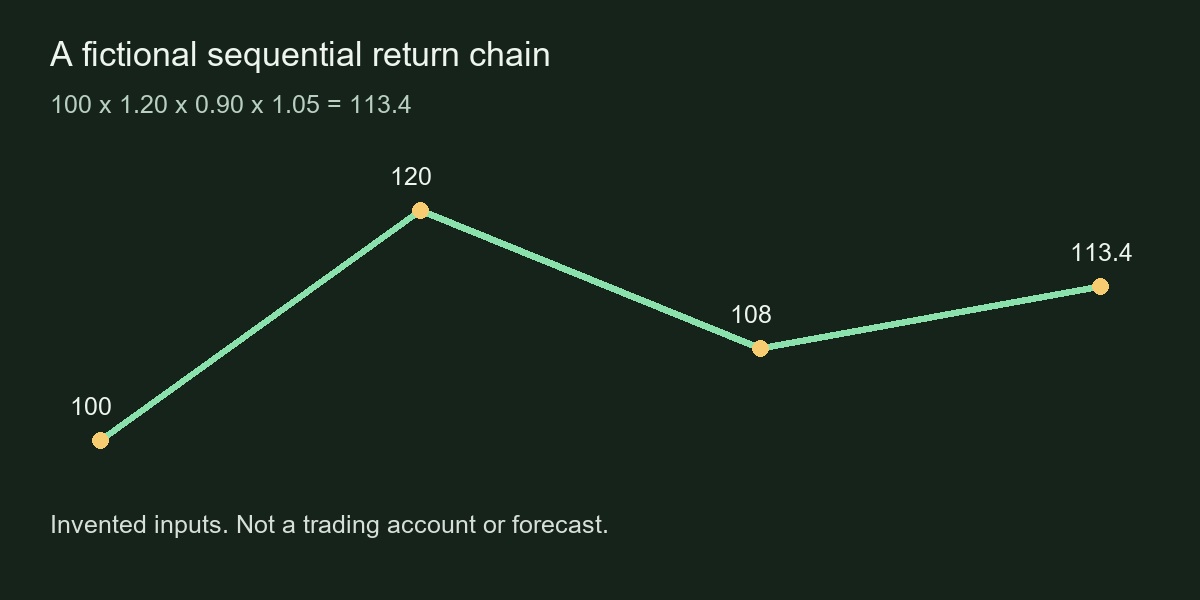
S1 spans January 1 to February 1, S2 February 1 to March 1, and S3 March 1 to April 1, using start-inclusive/end-exclusive intervals. The returns are twenty, negative ten and five percent, all supplied as strings. The declared cash-flow-adjusted series multiplies to factor 1.134, a 13.4-percent linked change. Its arithmetic sum is fifteen percentage points. Reordering the input does not change the sorted series. The figure illustrates this exact multiplication, not a historical equity curve or a modelled forecast.
Change one assumption at a time
The gap and overlap cases change the middle start date. They preserve an arithmetic sum but suppress the linked return and factor. The zero-middle case produces twenty-six percent, from 1.20 times 1 times 1.05. The terminal-total-loss case produces negative one hundred percent. A total-loss segment before a later segment is rejected rather than imply a recoverable zero capital base. Comparability variants alter a single key in B while C and D keep their original limitations. None of the variants is an alternative historical fill.
Keep the software and evidence boundaries separate
The tools validate syntax and compare or multiply declared inputs. They do not fetch statements, determine correct accounting treatment, verify the completeness of a record population or inspect a private account. A matching label can be wrong in the real world. An adjacent date range can conceal a change of strategy or capital. Financial validation, source authentication and suitability remain null. Independent software references test implementation correctness on authored inputs only; their case count is not a count of independently validated trading strategies.
Move from exercise to actual review
For a genuine comparison, collect the issuer record, account boundary, measurement dates, return definition, currency, status and calculation policy. Resolve cash-flow treatment and interval conventions before using a chain. Retain unanswered questions instead of defaulting to the most favourable interpretation. Do not upload private account details into a shared browser or present the example's data as your own history. The packet is freely accessible without a signup. Its purpose is to make analytical distinctions inspectable, not recommend a provider, allocate capital or promise a result.
Complete packet downloads
Base comparison input
{
  "version": 1,
  "baseline_id": "A",
  "records": [
    {
      "id": "A",
      "issuer": "Example Cup",
      "event": "Example 2025",
      "division": "Annual Example",
      "start": "2025-01-01",
      "end": "2026-01-01",
      "currency": "XCU",
      "basis": "net-time-weighted",
      "status": "final",
      "return_pct": "20"
    },
    {
      "id": "B",
      "issuer": "Example Cup",
      "event": "Example 2025",
      "division": "Annual Example",
      "start": "2025-01-01",
      "end": "2026-01-01",
      "currency": "XCU",
      "basis": "net-time-weighted",
      "status": "final",
      "return_pct": "15"
    },
    {
      "id": "C",
      "issuer": "Example Cup",
      "event": "Example 2025",
      "division": "Annual Example",
      "start": "2025-01-01",
      "end": "2026-01-01",
      "currency": "YCU",
      "basis": "net-time-weighted",
      "status": "final",
      "return_pct": "25"
    },
    {
      "id": "D",
      "issuer": "Example Cup",
      "event": "Example 2025",
      "division": "Annual Example",
      "start": "2025-01-01",
      "end": "2026-01-01",
      "currency": "XCU",
      "basis": null,
      "status": "final",
      "return_pct": "30"
    }
  ]
}
Base sequential input
{
  "version": 1,
  "account": "Fictional Account A",
  "currency": "XCU",
  "basis": "supplied-cashflow-adjusted",
  "cashflow_adjusted": true,
  "segments": [
    {
      "id": "S1",
      "start": "2025-01-01",
      "end": "2025-02-01",
      "return_pct": "20"
    },
    {
      "id": "S2",
      "start": "2025-02-01",
      "end": "2025-03-01",
      "return_pct": "-10"
    },
    {
      "id": "S3",
      "start": "2025-03-01",
      "end": "2025-04-01",
      "return_pct": "5"
    }
  ]
}