How to Read a Trading Competition Result Without Overstating It
Understand issuer, division, period, account rules and the boundary between a competition placing and a wider claim about trading skill.
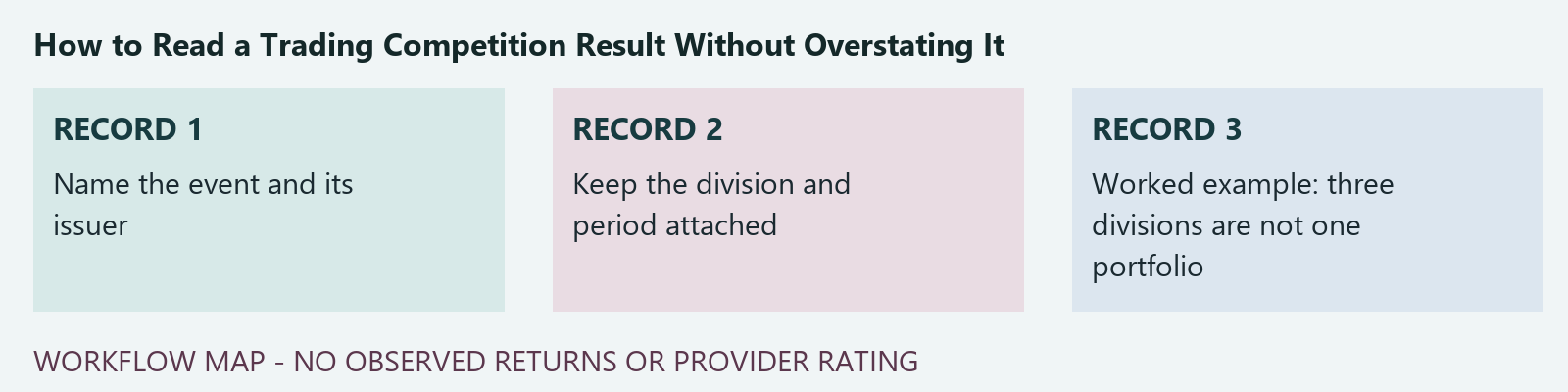
Name the event and its issuer
Write the full event name, organiser and year before recording the title or return. Similar-sounding competitions can have unrelated rules and participants. An award issued by one publication is not automatically a placing in another organiser's event. Treat the official results page as evidence for the exact result it publishes, not as confirmation of every promotional phrase repeated elsewhere. If the original result cannot be located, retain the supplied wording as an unconfirmed claim and ask for its primary record.
Keep the division and period attached
Record the division, covered dates, account class and placing together. A monthly winner and an annual fourth-place result answer different questions. Do not drop the period when shortening a sentence or turn a division winner into an overall event winner. Keep return attribution equally narrow: a competition account result is not the founder's unrelated personal year, a later signal-model summary or a customer's account outcome. A reader should not have to reconstruct these distinctions from a distant footnote.
Worked example: three divisions are not one portfolio
Imagine a fictional contestant reporting 20% in an annual division, 8% in a quarterly division and 4% in a monthly division. Adding them gives 32 percentage points, but that is not automatically a compounded account return, a capital-weighted portfolio result or three independent samples. The intervals can overlap and the accounts can use different capital. To describe an aggregate, request the convention, capital allocation and account boundaries. Do not present this invented arithmetic as an official competition calculation or choose a convention because it gives the biggest headline.
Read risk and eligibility beside return
Ask what records the organiser checks, whether accounts are live or simulated, what funding changes are allowed and how positions at the boundary are treated. A cumulative result does not reconstruct drawdown, leverage, exposure or the equity path. A dramatic percentage can reflect a risk profile unsuitable for another account. CME margin references and SEC execution guidance explain general mechanics but do not certify the contestant or the competition rules. The source for those rules must remain the actual organiser.
Compare only an adequately defined population
The participant list, admission dates and division rules matter if the question is comparative. A selected group of winners cannot establish the typical entrant's experience. Withdrawn accounts and missing records belong in the population design. A ranking across historical years also introduces different market environments and rule versions. Avoid replacing those gaps with invented factor scores or a universal league table. Qualitative discussion can still be useful when it accurately states which records were inspected and which comparative questions remain unanswered.
Publish credentials as bounded background
Competition evidence can establish a particular achievement under stated conditions. It does not guarantee a transferable strategy, future performance or subscriber execution. Preserve the dated result and distinguish any later editorial interpretation from the organiser's record. Correct a wrong issuer, year or division visibly instead of quietly changing the title. This chapter supplies a reading protocol, not a new competition panel or confirmation of every historical award in the archive. The blank credential record helps keep each achievement attached to its own source and scope.
Decision record
| Question | Record to retain | Decision boundary |
|---|---|---|
| Issuer | Official event name and source URL | Similar titles do not imply the same competition |
| Scope | Year, division, dates and account class | A division placing is not an overall victory |
| Aggregate | Account boundaries and calculation convention | Summed percentages are not automatically portfolio return |
| Transferability | Product or subscriber evidence separately | A credential cannot supply a later product track record |
Blank working record
The worksheet contains column headings only. Enter your own dated observations, keep absent evidence marked unknown, and do not treat the file as certification.
 Download worksheet (CSV)
Primary references
- CFA Institute: GIPS standards and scope
- CME: tick movements and contract specifications
- SEC: order types and execution limitations
These documents support mechanisms and source definitions, not a tested trading result or a recommendation. Accessed 9 October 2026. The decision workflow and invented examples above are editorial exercises.
Keep reading
Publication methodology | Working glossary | Source and correction policy